How to Use Ratios in Real Life: 10 Worked Examples
Ten everyday ratio problems worked out: salad dressing, unit prices, map distances, a 5:3:2 budget, concrete, photo prints, cleaner dilution, and soil.
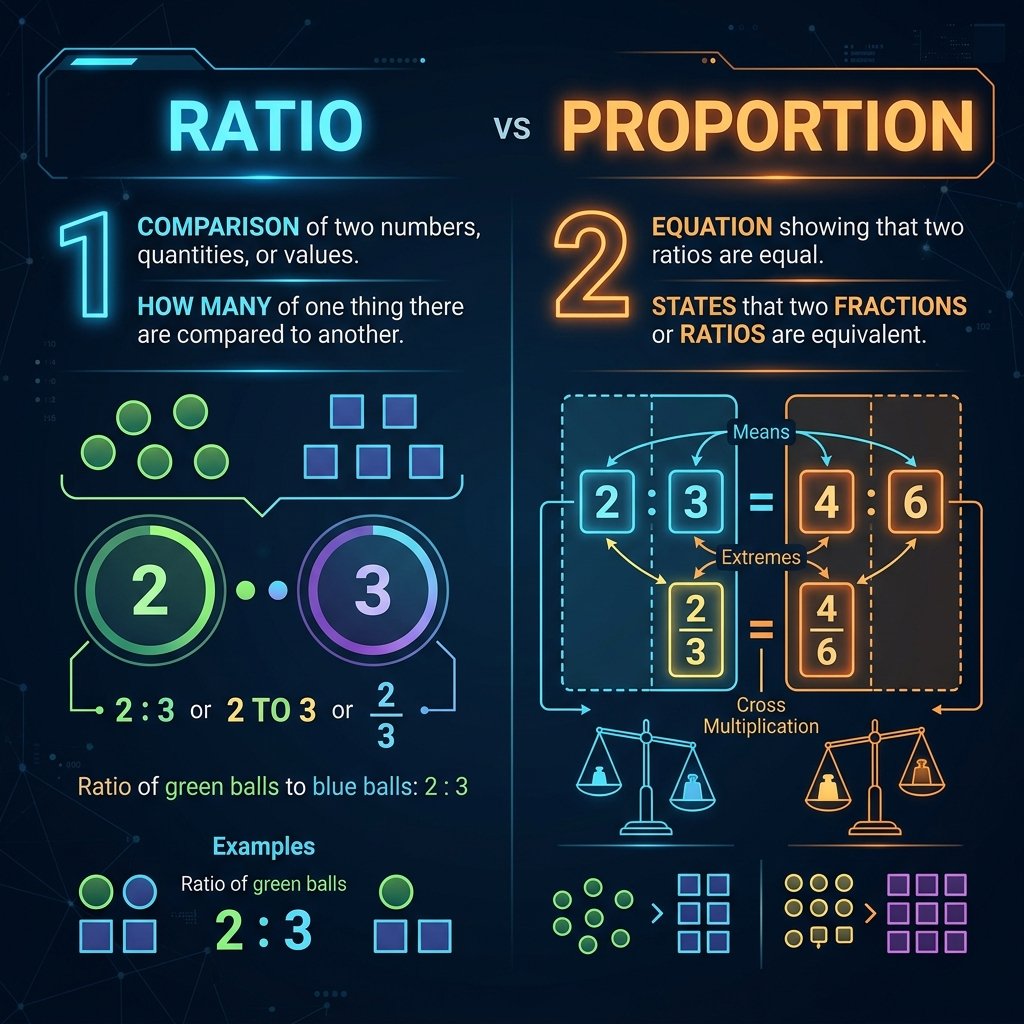
A ratio such as 2 : 3 says “for every 2 of the first thing, there are 3 of the second.” It describes a pattern, not the actual amounts, which is exactly why ratios are useful away from the classroom: the pattern stays the same whether you’re making one glass or a whole jug. (For the full definition, see What Is a Ratio?.)
Below are ten everyday problems, each worked out in a few lines. Most of them use one of three moves:
- Sharing a total: add the parts, divide the total by that sum, then multiply. See dividing in a ratio.
- Scaling: multiply or divide every part by the same number. See equivalent ratios.
- Comparing: turn each ratio into one number, such as a price per gram. See how to compare ratios.
1. Salad dressing (sharing a total)
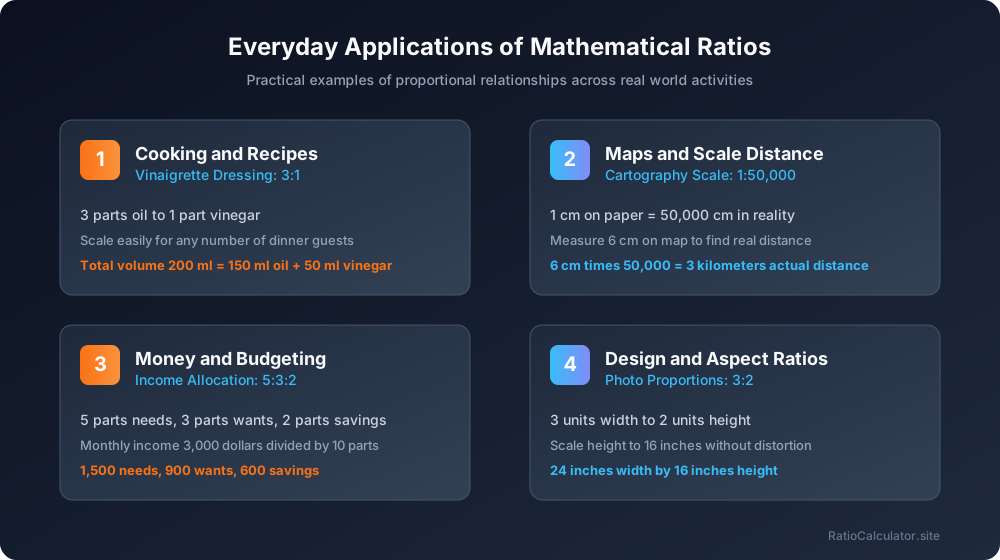
A vinaigrette uses oil : vinegar = 3 : 1, and you want 200 ml in total. There are 4 parts, so one part is 50 ml: 150 ml oil and 50 ml vinegar.
2. Unit prices (comparing)
Detergent A is 60 oz for $12, and detergent B is 80 oz for $20. Price per ounce: 12 ÷ 60 = $0.20 and 20 ÷ 80 = $0.25. A is the better deal, even though B is the bigger bottle.
3. Map distances (scaling)
On a 1 : 50,000 map, two towns are 6 cm apart. In real life that’s 6 × 50,000 = 300,000 cm, which is 3 km. (100,000 cm = 1 km.) More in scale drawings and maps.
4. A monthly budget (sharing a total)
The common 50/30/20 budget is a ratio of needs : wants : savings = 5 : 3 : 2. On $3,000 a month, one part is $3,000 ÷ 10 = $300, so that’s $1,500 needs, $900 wants, and $600 savings.
5. Shooting practice (writing a ratio)
A player makes 24 of 40 shots. Missed shots = 40 − 24 = 16, so made : missed = 24 : 16 = 3 : 2. As a percentage of all shots, that’s 24 ÷ 40 = 60%.
6. Field-trip supervision (scaling)
A trip needs 1 adult for every 8 students, and 72 students are going. 72 ÷ 8 = 9, so 9 adults. If the number of students doesn’t divide evenly, round up: 75 students would still need 10 adults, not 9.375.
7. Concrete (sharing a total)
A 1 : 2 : 4 mix of cement : sand : gravel, for 28 cubic feet in total. There are 7 parts, so one part is 4 ft³: 4 cement, 8 sand, 16 gravel. More in the construction examples.
8. Photo prints (scaling)
A camera photo is 3 : 2 (width : height). For a print 16 inches tall, the scale factor is 16 ÷ 2 = 8, so the width is 3 × 8 = 24 inches. Any other width would crop or stretch the photo. The Aspect Ratio Calculator does this for screen and video sizes.
9. Diluting a cleaner (sharing a total)
A label says to dilute 1 : 9 with water, and the spray bottle holds 500 ml. That’s 10 parts, so one part is 50 ml: 50 ml concentrate and 450 ml water. Some labels mean “1 part in 9 total” instead, so check the instructions. The everyday math examples explain how to tell.
10. Scaling down a soil blend (scaling)
A 28-pound bag of garden soil blend contains compost, topsoil, and sand in the ratio 4 : 2 : 1 (16 lb, 8 lb, and 4 lb). You only need 7 pounds for a small planter. The scale factor is 7 ÷ 28 = 1/4, so you need 4 lb compost, 2 lb topsoil, and 1 lb sand.
Two things to watch in real problems
- Order matters. A drink made 2 parts juice to 3 parts water is weaker than one made 3 : 2. Write the labels next to the numbers.
- Not everything scales. Doubling a recipe doubles the flour, but not necessarily the baking time. A taxi with a fixed pickup fee doesn’t cost twice as much for twice the distance. Before scaling, ask: “If one thing doubles, does the other really double too?” The lesson on solving proportions has more examples of this.