How to Find Equivalent Ratios and Check If Two Ratios Are Equal
Build equivalent ratios by multiplying or dividing both terms, hit a target number, and test whether two ratios are equal using cross products.
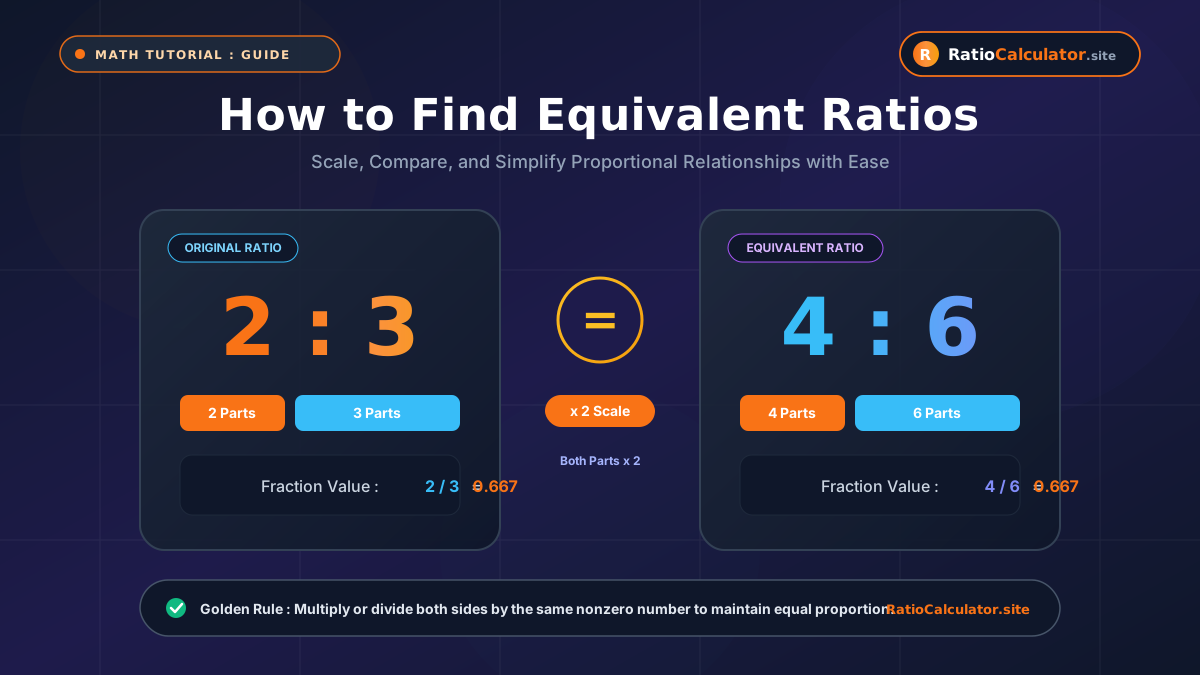
Equivalent ratios describe the same relationship with different numbers. 2 : 3, 4 : 6, and 20 : 30 are all equivalent: each says “2 of the first for every 3 of the second.” To make one, multiply or divide both terms by the same nonzero number. That single rule is the whole method.
To build an equivalent ratio quickly, the Ratio Scaling Calculator multiplies both terms by any factor. To test two ratios, the Proportion Calculator compares their cross products.
Making equivalent ratios
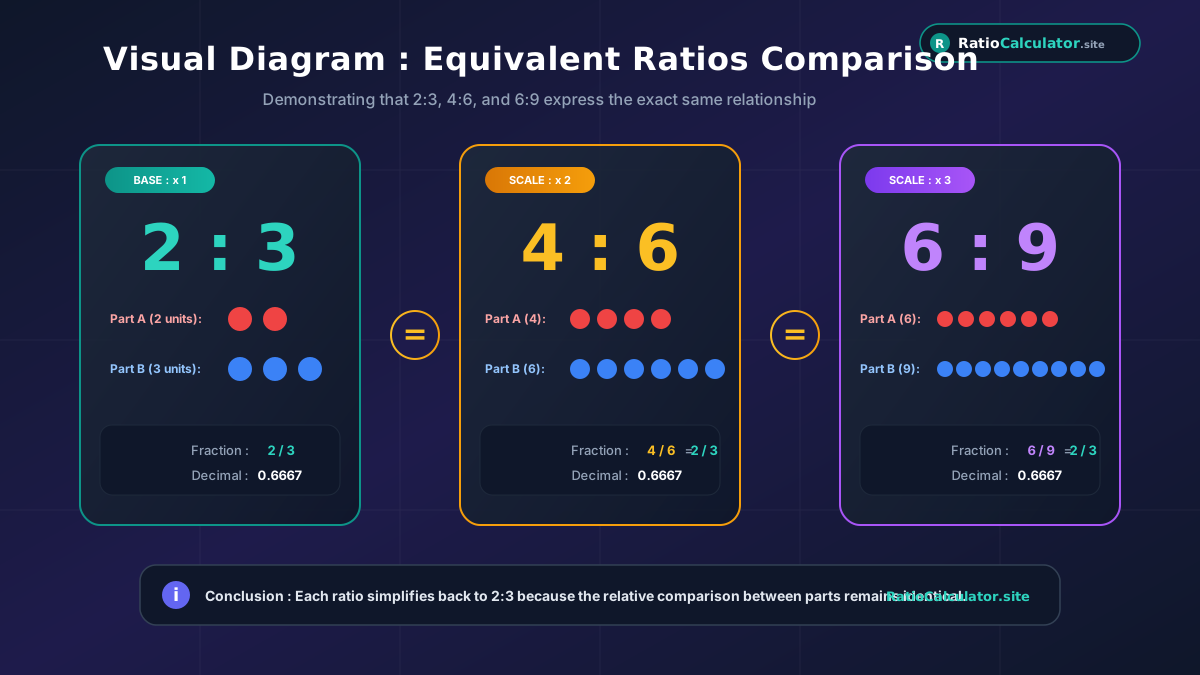
Multiply both terms. From 3 : 7: ×2 gives 6 : 14, ×3 gives 9 : 21, and ×5 gives 15 : 35. All four ratios are equivalent.
Divide both terms. From 20 : 30, dividing both by 10 gives 2 : 3. You could also divide by 5 (4 : 6) and then by 2 (2 : 3). Any route gives the same simplest form.
In symbols: for any nonzero number k, a : b = (a × k) : (b × k). A k bigger than 1 scales up, and a k between 0 and 1 scales down.
Hitting a target number
Usually you need the equivalent ratio where one term is a particular number. Find the factor that turns the known term into the target, then apply it to the other term.
Example. Boys : girls = 2 : 5, and there are 20 girls. The girls’ term went from 5 to 20, a factor of 4. So boys = 2 × 4 = 8, and the equivalent ratio is 8 : 20.
Example with a fraction factor. A recipe uses flour : milk = 3 : 2. You only have 500 ml of milk. The factor is 500 ÷ 2 = 250, so flour = 3 × 250 = 750 g.
If the factor isn’t obvious, set it up as a proportion and cross-multiply. How to solve proportions covers that.
Checking whether two ratios are equal
There are two reliable tests.
Test 1: cross products. For a : b and c : d, compare a × d with b × c.
- 3 : 4 and 9 : 12: 3 × 12 = 36 and 4 × 9 = 36. Equal.
- 2 : 5 and 4 : 9: 2 × 9 = 18 and 5 × 4 = 20. Not equal.
Test 2: simplest form. Reduce both. If they reduce to the same ratio, they’re equivalent.
- 15 : 25 → 3 : 5, and 6 : 10 → 3 : 5. Equal.
- 12 : 20 → 3 : 5, but 4 : 7 is already in simplest form. Not equal.
Cross products are quicker for a single pair. Simplest form is better when you’re sorting many ratios into groups. To find which of two unequal ratios is larger, see how to compare ratios.
Every ratio has one simplest form
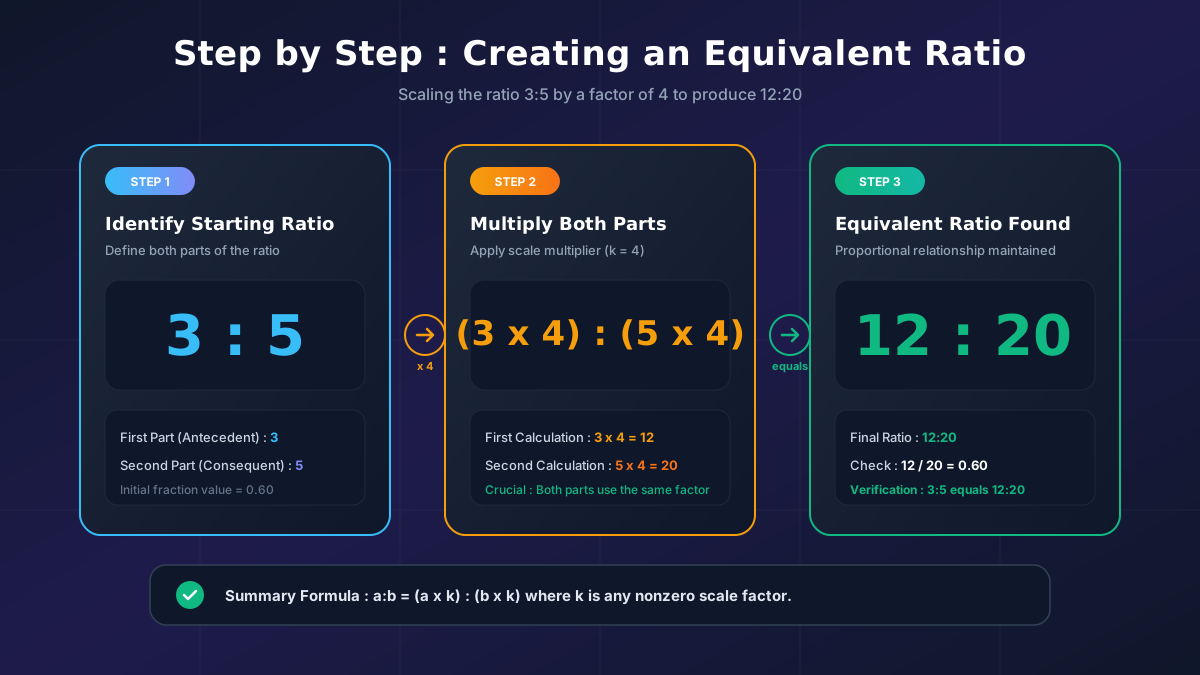
All the ratios equivalent to 3 : 4 (6 : 8, 9 : 12, 12 : 16, 15 : 20, and so on) reduce to the same simplest form, 3 : 4, where the terms share no factor other than 1. That’s why simplifying works as a test: equivalent ratios always share a simplest form, and ratios that aren’t equivalent never do. For three ways to simplify, see how to simplify a ratio.
Where you’ll use this
- Scaling a recipe. Pancakes with flour : milk = 2 : 1 cups. A triple batch is 6 : 3 cups, the same ratio, so the same batter.
- Map scales. On a 1 : 100,000 map, 1 cm stands for 100,000 cm (1 km). The equivalent ratio 2 : 200,000 says that 2 cm stands for 2 km.
- Mixing paint. 1 part blue to 4 parts white is the same color as 3 parts to 12. Write the ratio down before you start, because matching a color by eye later is much harder.
Common mistakes
- Changing only one term. 3 : 5 → 6 : 5 is a different ratio. Both terms must change.
- Adding instead of multiplying. Adding 3 to both terms of 4 : 7 gives 7 : 10, which is not equivalent (4/7 ≈ 0.571 and 7/10 = 0.7).
- Multiplying by zero. 0 : 0 isn’t a ratio at all. The factor must be nonzero.
- Judging by appearance. 4 : 6 and 6 : 9 look different but are both 2 : 3. Test them; don’t eyeball them.