How to Calculate a Ratio From Counts, Measurements, and Totals
Turn raw numbers into a ratio: counts, mixed units, a total and one part, or phrases like twice as many. Worked examples and the mistakes to avoid.
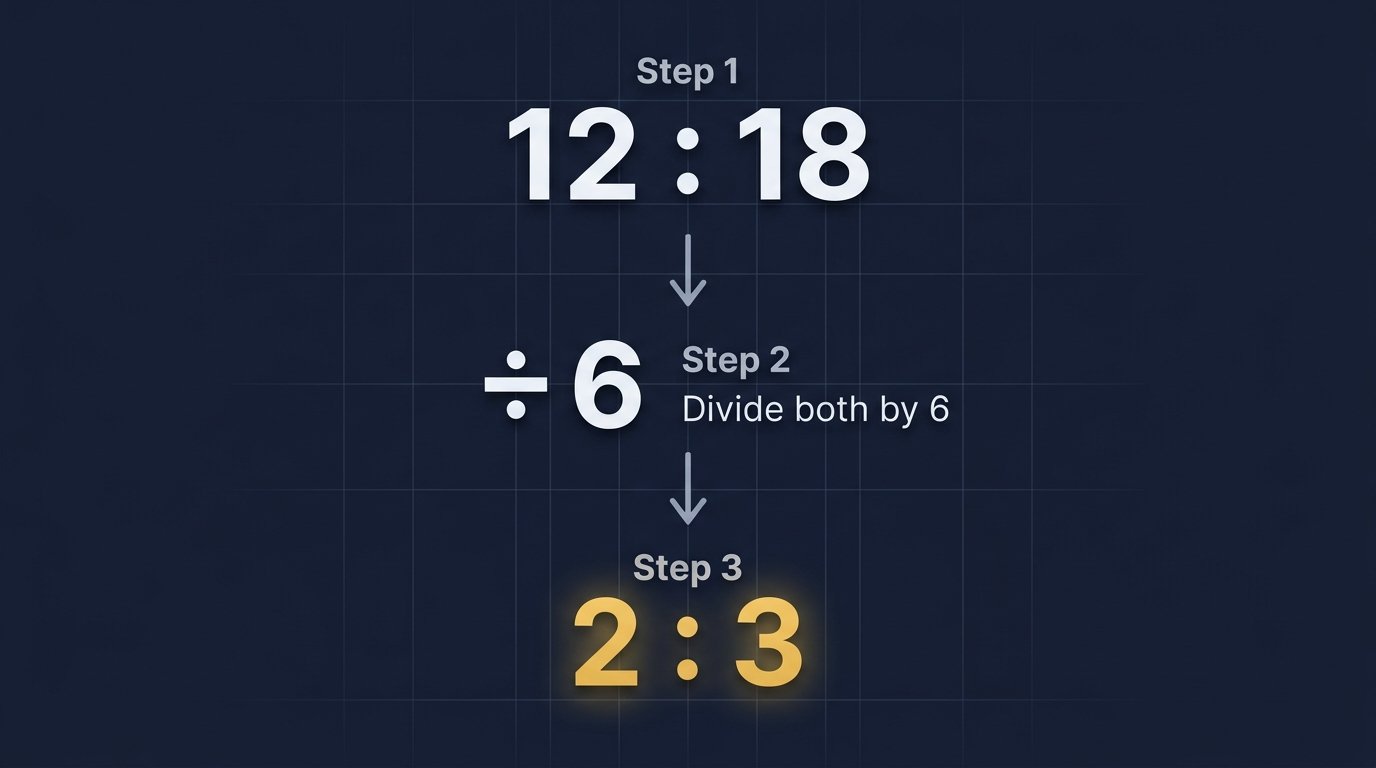
To calculate a ratio, write the two quantities in the order the question names them, make sure they use the same unit, and divide both by their greatest common factor (GCF). 12 boys and 18 girls gives boys : girls = 12 : 18, and dividing both by 6 gives 2 : 3.
That part is quick. Most mistakes happen earlier, when the numbers arrive in an awkward form: in different units, as a total and one part, or hidden in a sentence like “twice as many.” This guide covers each of those cases. If you need the background on what a ratio means, start with What Is a Ratio?. To check an answer, the Ratio Simplifier shows the GCF it used.
The basic method
- Name the two quantities, in order. “The ratio of sugar to flour” means sugar first.
- Put them in the same unit.
- Write them as A : B.
- Divide both by their GCF to get simplest form.
Example: sugar and flour. A recipe uses 150 g of sugar and 450 g of flour. Both are in grams, so sugar : flour = 150 : 450. The GCF is 150, which gives 1 : 3.
Example: walking and jogging. You walk 600 m and jog 900 m. Walking : jogging = 600 : 900. The GCF is 300, which gives 2 : 3.
If you can’t spot the GCF straight away, divide by any common factor and repeat until nothing else divides both. The lesson on how to simplify a ratio shows three ways to do it.
When the units don’t match
Convert first, then write the ratio. Comparing the raw numbers gives a wrong answer that looks perfectly reasonable.
| Quantities | Wrong | Convert | Right |
|---|---|---|---|
| 2 hours to 30 minutes | 2 : 30 | 120 min : 30 min | 4 : 1 |
| 1.2 m to 80 cm | 1.2 : 80 | 120 cm : 80 cm | 3 : 2 |
| 750 g to 2 kg | 750 : 2 | 750 g : 2000 g | 3 : 8 |
Convert to the smaller unit. That usually avoids decimals.
When you’re given a total and one part
Questions often give you the whole and one group, then ask about a different pair. Find the missing group by subtracting first.
Example. 60 students took a test and 15 passed.
- Passed : failed. Failed = 60 − 15 = 45, so 15 : 45 = 1 : 3.
- Passed : all students = 15 : 60 = 1 : 4.
Both are correct ratios, but they answer different questions. The first compares two groups (part-to-part). The second compares a group with the whole (part-to-whole), which is the one you need for a fraction or percentage: 1/4 = 25% passed.
When the ratio is hidden in a sentence
Some questions never give you two numbers. Translate the words.
- “There are twice as many girls as boys.” For every 1 boy there are 2 girls, so girls : boys = 2 : 1.
- “The width is three-quarters of the length.” Width : length = 3/4 : 1 = 3 : 4.
- “For every 5 cars, 2 are electric.” Electric : all cars = 2 : 5, and electric : non-electric = 2 : 3.
The third one is a common trap. “For every 5 cars” tells you the whole, so the other group is 5 − 2 = 3.
Ratios with decimals, fractions, or zero
- Decimals: multiply both terms by 10, 100, or 1000 until they’re whole numbers, then simplify. 2.5 : 7.5 becomes 25 : 75 = 1 : 3. More in ratio problems with decimals.
- Fractions: multiply both terms by the lowest common denominator. 1/2 : 1/3 becomes 3 : 2. More in ratio problems with fractions.
- Zero: a team with 5 wins and 0 losses has a win : loss ratio of 5 : 0. That’s a valid description, but it has no decimal value, because 5 ÷ 0 is undefined.
Common mistakes
- Reversing the order. 3 cats and 5 dogs is cats : dogs = 3 : 5, not 5 : 3. Write the labels above the numbers.
- Mixing units. 2 hours to 30 minutes is 4 : 1, not 2 : 30.
- Mixing up part-to-part and part-to-whole. A drink that’s 2 parts concentrate to 8 parts water is 2 out of 10, so 20% concentrate, not 25%.
- Stopping before simplest form. 24 : 36 → 4 : 6 isn’t finished. Divide by 2 again to get 2 : 3.
What to read next
- To scale a ratio up or down, see how to find equivalent ratios.
- To turn a ratio into percentages, see how to convert a ratio to a percentage.
- To decide which of two ratios is bigger, see how to compare ratios.
- To split a total in a given ratio, see how to divide a number in a given ratio.