How to Compare Ratios: 4 Methods and When to Use Each
Find the larger of two ratios with decimals, cross-multiplication, a common second term, or fractions. Plus ranking several ratios and real-world checks.
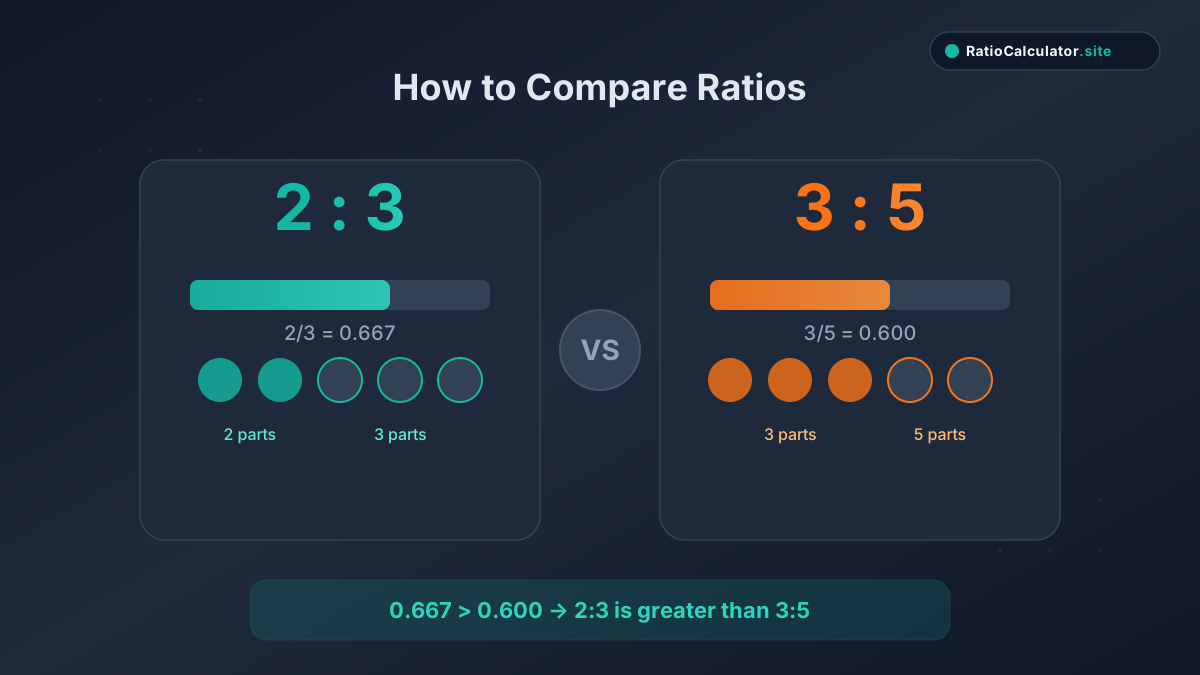
To compare two ratios, turn each into a single number by dividing its first term by its second, then compare those numbers. For 2 : 3 and 3 : 5: 2 ÷ 3 = 0.667 and 3 ÷ 5 = 0.6, so 2 : 3 is the larger ratio.
That surprises people, because both numbers in 3 : 5 are bigger. But a ratio’s size depends on the relationship between its terms, not on the terms themselves. Below are four ways to compare, with one example each and a note on when each method is the quickest. (To check whether two ratios are exactly equal, see how to find equivalent ratios.)
Method 1: Decimals
Divide the first term by the second in each ratio, and compare.
Compare 7 : 10 and 5 : 8. 7 ÷ 10 = 0.700 and 5 ÷ 8 = 0.625, so 7 : 10 is larger.
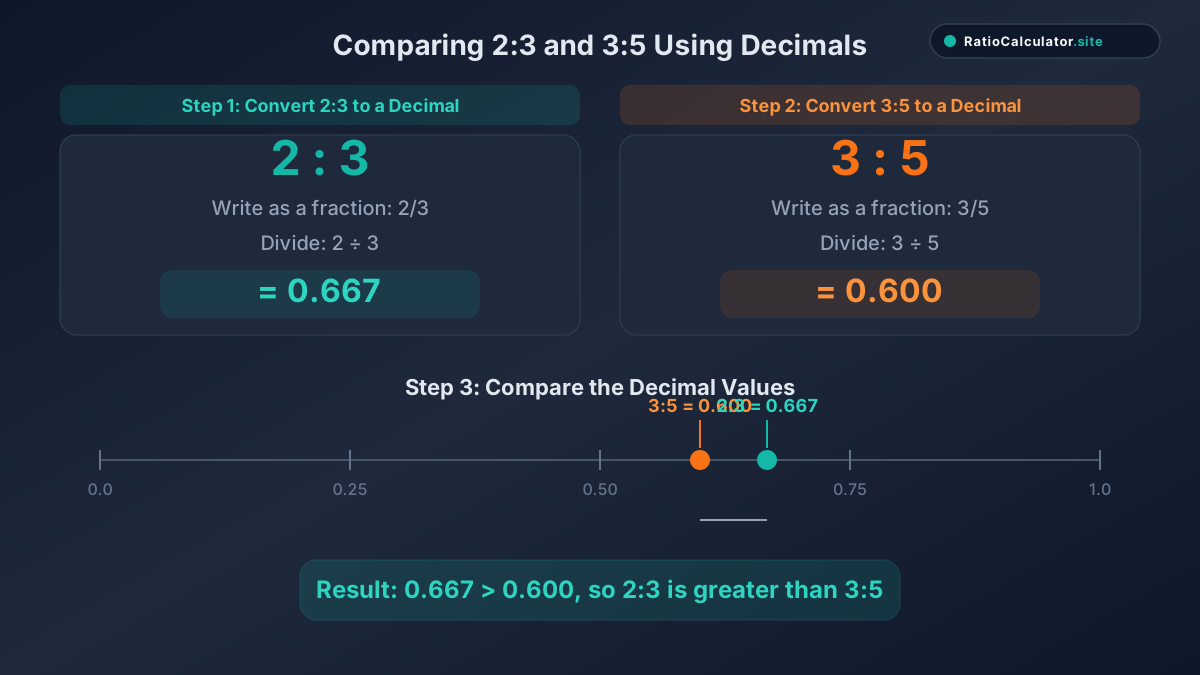
Best when: you have a calculator, or you’re comparing more than two ratios.
Method 2: Cross-multiplication
To compare a : b with c : d, work out a × d and c × b. Whichever product is larger belongs to the larger ratio. If the products are equal, so are the ratios.
Compare 3 : 4 and 5 : 7. 3 × 7 = 21 and 5 × 4 = 20. Since 21 > 20, 3 : 4 is larger.
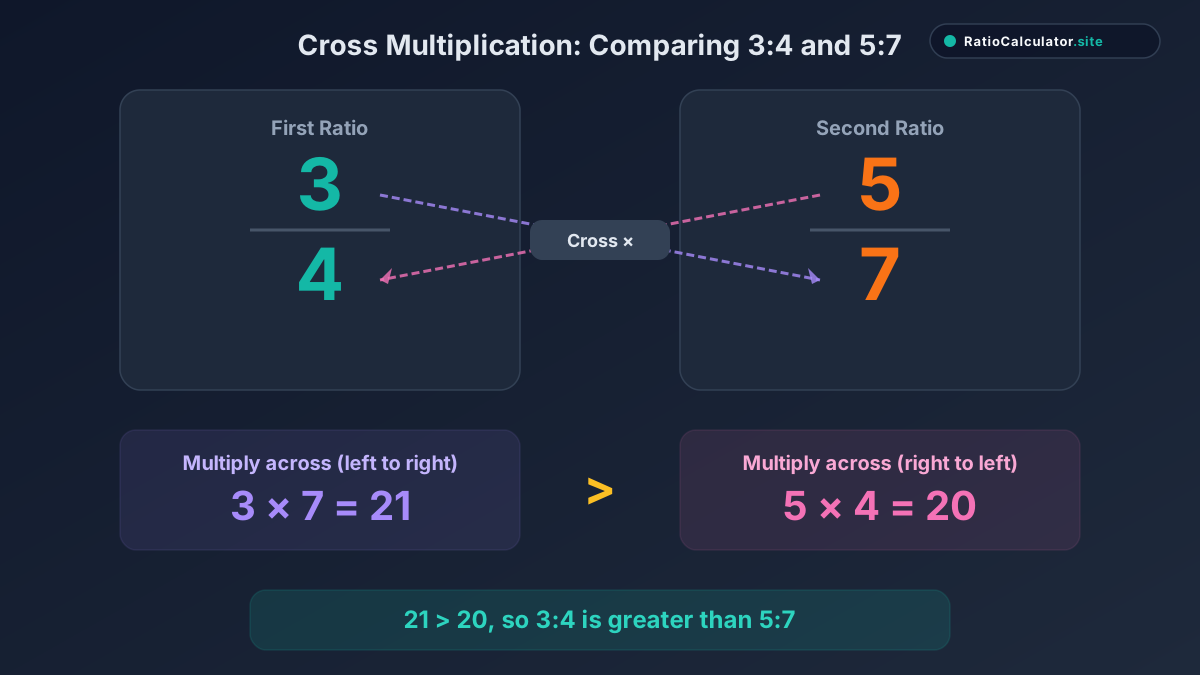
Keep track of which product goes with which ratio: a × d belongs to a : b, because a is its first term.
Best when: you’re working by hand and the numbers are small. There are no decimals to round.
Method 3: Make the second terms match
Scale both ratios so their second terms are equal, then compare the first terms.
Compare 4 : 7 and 5 : 9. The lowest common multiple of 7 and 9 is 63. Multiply 4 : 7 by 9 to get 36 : 63, and 5 : 9 by 7 to get 35 : 63. Since 36 > 35, 4 : 7 is larger.
Best when: one second term is already a multiple of the other. For 3 : 4 and 5 : 8, double the first to get 6 : 8, and 6 > 5 settles it at once.
Method 4: Fractions
Write each ratio as a fraction and compare the fractions using a common denominator.
Compare 5 : 6 and 7 : 9. As fractions, 5/6 = 15/18 and 7/9 = 14/18, so 5 : 6 is larger.
This is really Method 3 written with fraction bars. Use whichever notation you’re more comfortable with.
Ranking three or more ratios
Use decimals. Converting every ratio to one number makes ranking easy.
Rank 1 : 3, 2 : 5, 3 : 8, and 4 : 9. As decimals: 0.333, 0.400, 0.375, and 0.444. From largest to smallest: 4 : 9 > 2 : 5 > 3 : 8 > 1 : 3.
In real life: decide what “larger” should mean first
Before comparing, check that the ratios are written the same way round, so that a larger number means the same thing in both.
- Recipes. One cake uses flour : sugar = 3 : 1, and a cookie recipe uses 5 : 2. To ask “which is sweeter?”, compare sugar per unit of flour: 1 ÷ 3 = 0.33 and 2 ÷ 5 = 0.40. The cookies have more sugar for their flour.
- Shopping. Store A sells 500 g for $4 and store B sells 750 g for $5.50. Grams per dollar: 500 ÷ 4 = 125 and 750 ÷ 5.50 ≈ 136. Store B gives you more for your money.
- Maps. A 1 : 25,000 map shows more detail than a 1 : 50,000 map, because each centimeter stands for a shorter real distance (250 m instead of 500 m).
Common mistakes
- Comparing only the first terms. 5 : 8 is not larger than 3 : 4 just because 5 > 3. As decimals they’re 0.625 and 0.75.
- Comparing only the second terms. 4 : 7 is not smaller than 2 : 5 just because 7 > 5. It’s 0.571 against 0.4, so 4 : 7 is larger. A bigger second term only means a smaller ratio when the first terms are the same.
- Adding the terms. 3 : 4 and 2 : 5 both add to 7, but they’re nowhere near equal (0.75 against 0.4).
- Mixing the directions. Comparing a boys : girls ratio with a girls : boys ratio gives nonsense. Rewrite one of them first.