How to Use Ratios in Geometry: Area, Length, and Scale Examples
Master geometric ratios, scale factors, similar shapes, and area relationships. Learn why area scales with squared ratios with step by step examples.
Ratios play a central role throughout geometry, architectural design, and spatial modeling. From verifying similar triangles to calculating blueprint scale factors, understanding how linear dimensions relate to surface areas and volumes is essential for mathematics students and engineering professionals alike.
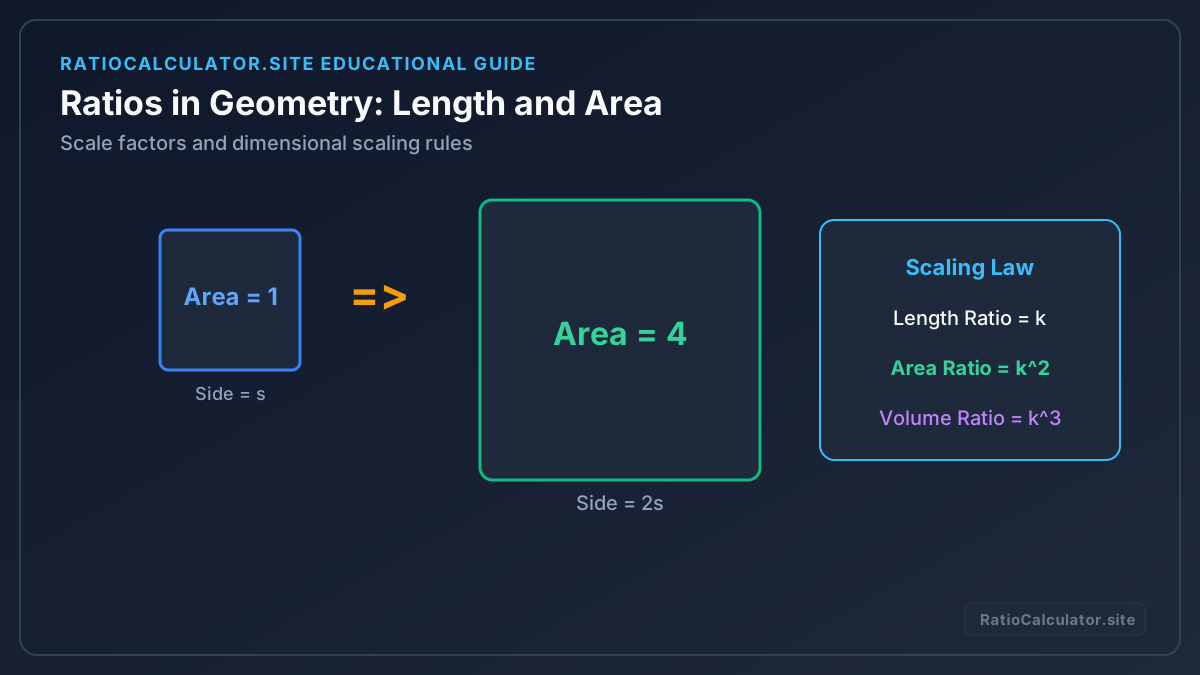
The most vital geometric concept to master is dimensional scaling: while linear measurements scale directly by a factor k, two dimensional areas scale by the square of that factor (k^2), and three dimensional volumes scale by the cube of that factor (k^3).
To scale geometric dimensions or solve proportions automatically, use the free Ratio Calculator on RatioCalculator.site.
Geometric Similarity and Scale Factors
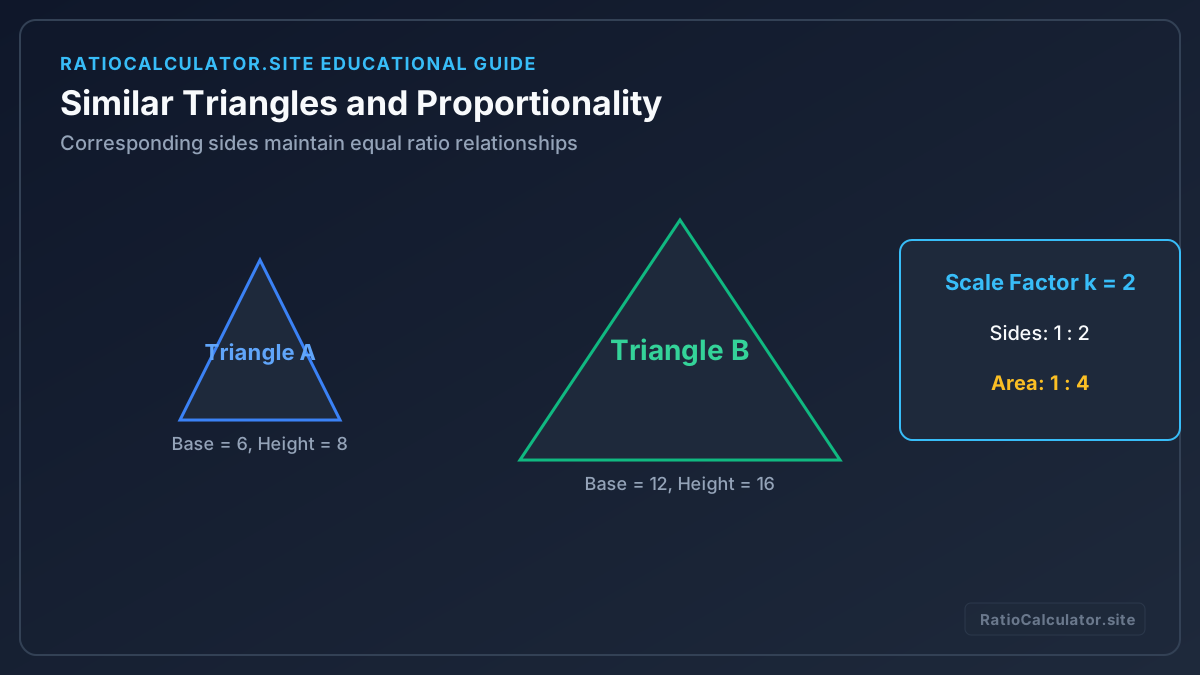
Two geometric figures are said to be mathematically similar if they have identical corresponding angles and proportional corresponding side lengths.
The ratio of any corresponding linear dimension (such as base, height, radius, or perimeter) between two similar figures defines the linear scale factor, denoted as k:
Linear Scale Factor k = Length in Shape 2 / Corresponding Length in Shape 1
If the linear scale factor between two similar triangles is 2, every side of the larger triangle is exactly twice as long as the matching side of the smaller triangle.
The Fundamental Law of Area Ratios
Why does area scale by k^2 rather than k? Consider a simple square with side length s:
- Initial Area = s * s = s^2
Now double the side length to 2s (linear factor k = 2):
- New Area = (2s) * (2s) = 4s^2
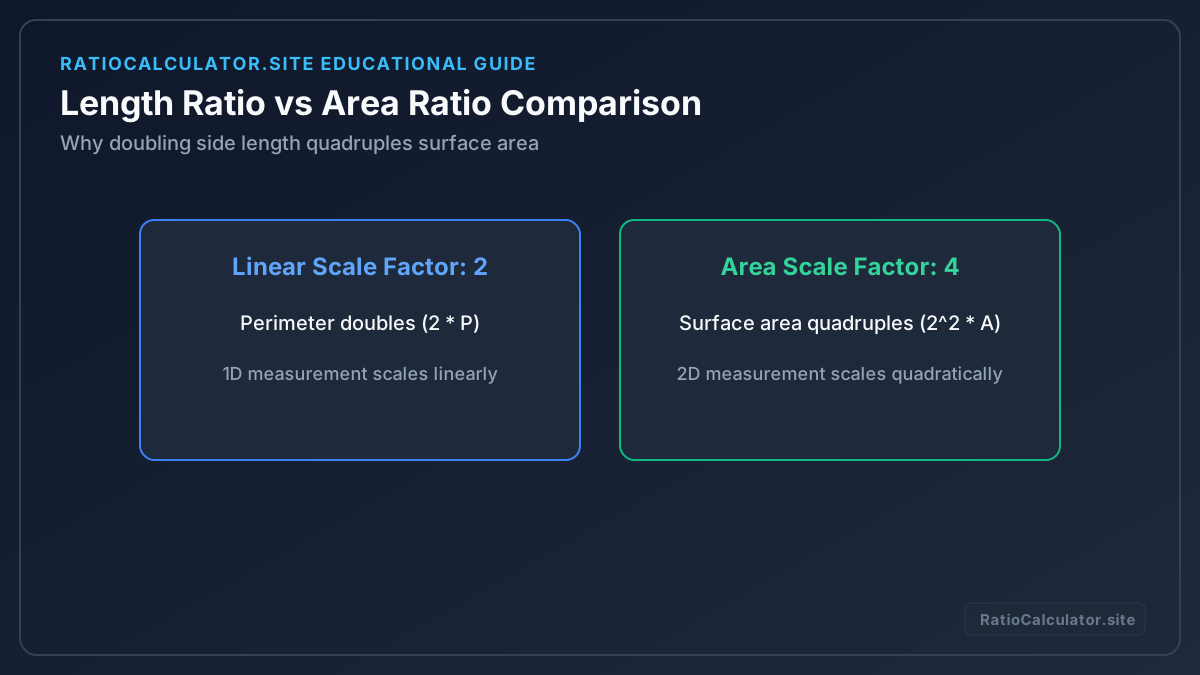
Even though the side length only doubled, the surface area quadrupled (2^2 = 4). Because area is a two dimensional measure calculated by multiplying two linear dimensions together, scaling each dimension by k multiplies the overall area by k * k = k^2.
The Dimensional Scaling Rules
- 1D Measurements (lengths, perimeters, circumferences, radii): Ratio = k
- 2D Measurements (surface areas, cross sections, base areas): Ratio = k^2
- 3D Measurements (volumes, capacities, masses of uniform density): Ratio = k^3
Practical Step by Step Geometry Examples
Example 1: Similar Rectangles and Area Expansion
A photo measuring 4 inches wide by 6 inches tall has an area of 24 square inches. It is enlarged uniformly so that its new width is 12 inches. What is the new area?
- Find the linear scale factor k:
- k = New Width / Old Width = 12 inches / 4 inches = 3
- Determine the area scale factor:
- Area factor = k^2 = 3^2 = 9
- Compute the new area:
- New Area = Original Area * k^2 = 24 square inches * 9 = 216 square inches
- Verification: New height = 6 * 3 = 18 inches. Area = 12 inches * 18 inches = 216 square inches.
Example 2: Circle Radii and Area Proportion
Two circular garden ponds have radii in the ratio 3 : 5. If the smaller pond has a water surface area of 54 square meters, what is the surface area of the larger pond?
- Linear ratio of radii = 3 : 5
- Area ratio = 3^2 : 5^2 = 9 : 25
- Set up the proportion: 9 / 25 = 54 / Area Larger
- Solve for Area Larger:
- Area Larger = (54 * 25) / 9
- Area Larger = 6 * 25 = 150 square meters
- Verification: 54 / 150 reduces to 9 / 25 by dividing both by 6.
Example 3: Finding Linear Scale from Area
Two similar triangles have areas of 32 square centimeters and 72 square centimeters respectively. If the base of the smaller triangle is 8 centimeters, what is the base of the larger triangle?
- Find the area ratio: 32 / 72 = 4 / 9 (simplified by dividing by 8)
- Because Area Ratio = k^2, take the square root to find linear scale factor k:
- k = sqrt(4 / 9) = 2 / 3
- Relate linear bases: Base Small / Base Large = 2 / 3
- Set up equation: 8 / Base Large = 2 / 3
- Cross multiply:
- 2 * Base Large = 24
- Base Large = 12 centimeters
- Verification: Linear ratio 8 : 12 = 2 : 3. Squared area ratio = (2/3)^2 = 4/9 = 32/72.
Common Mistakes in Geometric Ratios
- Scaling Area with Linear Factor: Multiplying area directly by k rather than k^2 is the most prevalent error in geometric problem solving.
- Applying Similarity Rules to Non Similar Shapes: You cannot apply scale factors to two rectangles or triangles unless they are confirmed to have identical angle proportions.
Contextual Internal Resources & Authority References
Expand your spatial and dimensional calculation capabilities with these recommended geometry tools and proportion guides:
- Interactive Calculators: Compute width-to-height screen dimensions with the Aspect Ratio Calculator and scale polygon blueprints with the Scale Factor Calculator.
- Related In-Depth Guides: Learn How to Use Ratios for Scale Drawings and Maps, explore comparative methods in How to Compare Ratios, and review How to Find Equivalent Ratios.
- Core Tool: Validate geometric scale factors effortlessly with the Ratio Calculator.
- Academic References: For formal proofs on similar shapes and area-volume scaling laws, consult Wolfram MathWorld Similar Shapes & Geometric Scaling and Britannica Geometric Similarity.
Frequently Asked Questions
What is the linear scale factor between two similar geometric shapes?
The linear scale factor is the ratio of any corresponding length or perimeter measurement between two similar shapes.
Why do area ratios equal the square of the linear ratio?
Because area is calculated by multiplying two linear dimensions together, each scaled by the linear factor k.
How do volume ratios relate to the linear scale factor?
Volume ratios equal the cube of the linear scale factor (k^3) because volume spans three dimensions.
How do you find the linear ratio if you only know the area ratio?
Take the square root of the simplified area ratio to determine the linear scale factor.
Do all circles have proportional geometric relationships?
Yes, all circles are mathematically similar to one another because their shapes depend strictly on a single radius dimension.
Can you use geometric ratio scaling on shapes that are not similar?
No, geometric ratio scaling strictly requires that shapes be similar with proportional matching angles and sides.
How do perimeters of similar shapes scale?
Perimeters are one dimensional linear measurements and scale directly with the linear factor k rather than k^2.