How to Calculate a Ratio (Complete Step by Step Guide + Formulas)
Learn how to calculate a ratio with simple steps, clear examples, and practical formulas. Simplify ratios, find equivalents, and convert to percentages.
A ratio is a way of comparing two quantities by showing how much of one thing exists relative to another. To calculate a ratio, you place the two numbers side by side separated by a colon, then divide both numbers by their greatest common factor to simplify.
Ratios appear everywhere in daily life. You use them when doubling a recipe, reading a map, splitting a bill, mixing paint, or comparing prices at the grocery store. Understanding how to calculate, simplify, and apply ratios gives you a practical math skill you can use in school, at work, and at home.
If you want to skip the manual math and get instant results, try the free Ratio Calculator on RatioCalculator.site. It simplifies ratios, solves for missing values, and shows every calculation step.
What Is a Ratio?
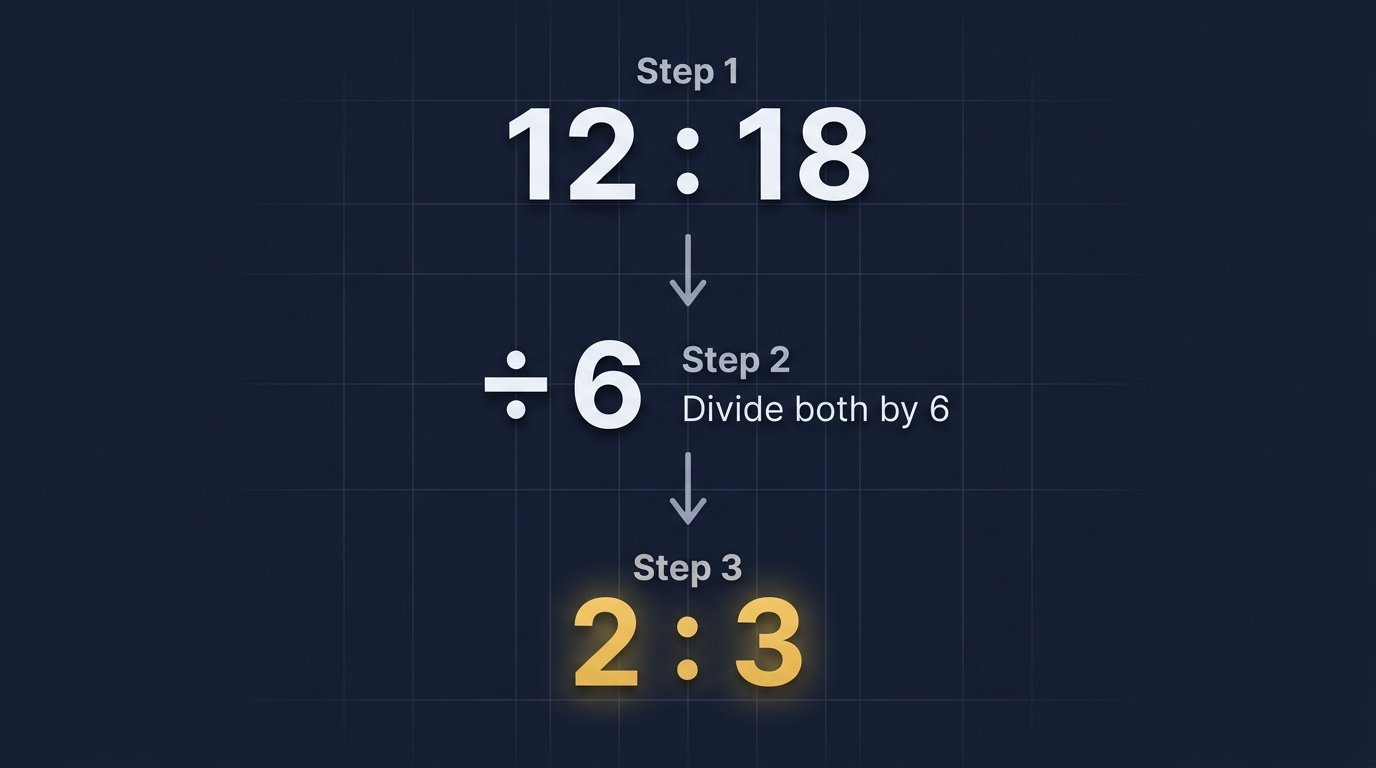
Quick Answer (Featured Snippet): To calculate a ratio between two quantities, write them side by side separated by a colon (A:B) or as a fraction (A/B), then divide both terms by their Greatest Common Factor (GCF) to reduce to simplest form. For example, 12 boys to 18 girls simplifies to 2:3 by dividing both numbers by 6.
A ratio compares two or more quantities and tells you how much of one exists for a given amount of the other. The two numbers in a ratio each represent a separate quantity.
Here are some simple examples:
- 3 boys and 5 girls in a class: the ratio of boys to girls is 3:5
- 2 apples and 6 oranges in a fruit bowl: the ratio of apples to oranges is 2:6, which simplifies to 1:3
- 10 minutes walking and 20 minutes running: the ratio of walking time to running time is 10:20, which simplifies to 1:2
A ratio can be written in three formats:
| Format | Example |
|---|---|
| Colon notation | 3:5 |
| Word format | 3 to 5 |
| Fraction format | 3/5 |
All three formats express the same comparison. Colon notation is the most common in everyday use.
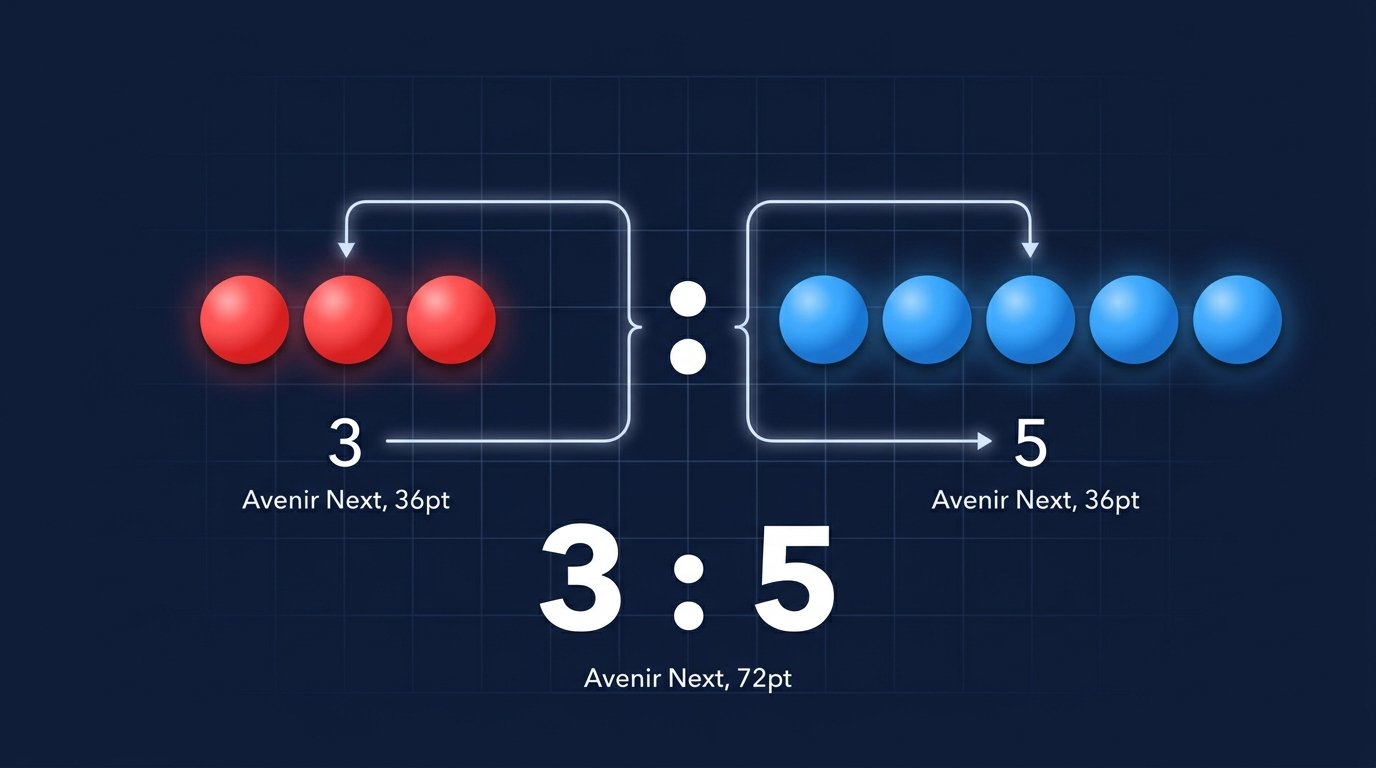
How to Calculate a Ratio
Calculating a ratio is straightforward. Follow these steps with any two quantities.
Step 1: Identify the Two Quantities
Decide what you are comparing. Make sure both values use the same unit of measurement. If one value is in meters and the other is in centimeters, convert them so they match.
Step 2: Write the Numbers Side by Side
Place the first quantity on the left and the second quantity on the right, separated by a colon.
Step 3: Find the Greatest Common Factor (GCF)
The greatest common factor is the largest number that divides evenly into both values.
Step 4: Divide Both Numbers by the GCF
This gives you the simplified ratio. For an in-depth walkthrough with a dedicated live calculator widget, check our detailed tutorial on How to Calculate a Ratio From Two Numbers.
Example 1: Boys and Girls
A classroom has 8 boys and 12 girls.
- Write the ratio: 8:12
- The GCF of 8 and 12 is 4
- Divide both: 8 ÷ 4 = 2, and 12 ÷ 4 = 3
- Simplified ratio: 2:3
Example 2: Sugar and Flour
A recipe calls for 150 grams of sugar and 450 grams of flour.
- Write the ratio: 150:450
- The GCF of 150 and 450 is 150
- Divide both: 150 ÷ 150 = 1, and 450 ÷ 150 = 3
- Simplified ratio: 1:3
Example 3: Distance Comparison
You walk 600 meters and then jog 900 meters.
- Write the ratio: 600:900
- The GCF of 600 and 900 is 300
- Divide both: 600 ÷ 300 = 2, and 900 ÷ 300 = 3
- Simplified ratio: 2:3
Ratio Formula
The basic ratio formula compares two quantities, A and B:
Ratio = A : B
This can also be written as a fraction:
Ratio = A / B
Where:
- A is the first quantity (sometimes called the antecedent)
- B is the second quantity (sometimes called the consequent)
- B must not equal zero, because division by zero is undefined
To express the ratio in simplest form, divide both A and B by their greatest common factor:
Simplified Ratio = (A ÷ GCF) : (B ÷ GCF)
For example, if A = 20 and B = 35:
- The GCF of 20 and 35 is 5
- 20 ÷ 5 = 4
- 35 ÷ 5 = 7
- Simplified ratio: 4:7
How to Simplify a Ratio
Simplifying a ratio means reducing both numbers to the smallest whole numbers that keep the same relationship. You do this by dividing both parts by their greatest common factor.
Example 1: Simplify 12:18
- Factors of 12: 1, 2, 3, 4, 6, 12
- Factors of 18: 1, 2, 3, 6, 9, 18
- Greatest common factor: 6
- 12 ÷ 6 = 2, and 18 ÷ 6 = 3
- Simplified ratio: 2:3
Example 2: Simplify 24:36
- Factors of 24: 1, 2, 3, 4, 6, 8, 12, 24
- Factors of 36: 1, 2, 3, 4, 6, 9, 12, 18, 36
- Greatest common factor: 12
- 24 ÷ 12 = 2, and 36 ÷ 12 = 3
- Simplified ratio: 2:3
Example 3: Simplify 45:60
- Factors of 45: 1, 3, 5, 9, 15, 45
- Factors of 60: 1, 2, 3, 4, 5, 6, 10, 12, 15, 20, 30, 60
- Greatest common factor: 15
- 45 ÷ 15 = 3, and 60 ÷ 15 = 4
- Simplified ratio: 3:4
Handling Decimal Ratios
When a ratio contains decimals, multiply both numbers by 10, 100, or 1000 to remove the decimal points first.
Example: Simplify 2.5:7.5
- Multiply both by 10: 25:75
- GCF of 25 and 75 is 25
- 25 ÷ 25 = 1, and 75 ÷ 25 = 3
- Simplified ratio: 1:3
How to Find Equivalent Ratios
Equivalent ratios express the same relationship between two quantities using different numbers. You create an equivalent ratio by multiplying or dividing both parts by the same number.
Example: Find three equivalent ratios for 2:5
| Operation | Calculation | Equivalent Ratio |
|---|---|---|
| Multiply both by 2 | 2×2 : 5×2 | 4:10 |
| Multiply both by 3 | 2×3 : 5×3 | 6:15 |
| Multiply both by 4 | 2×4 : 5×4 | 8:20 |
All of these ratios (2:5, 4:10, 6:15, 8:20) represent the exact same comparison.
Practical example: A lemonade recipe calls for 1 cup of lemon juice to 4 cups of water (1:4). If you want to make a larger batch using 3 cups of lemon juice, multiply both sides by 3 to get 3:12. You would need 12 cups of water.
Equivalent ratios are useful whenever you need to scale a quantity up or down while maintaining the same proportion. If you are evaluating two different ratios to see which one is larger or smaller, check out our guide on how to compare ratios.
Part to Part Ratio
A part to part ratio compares one group directly with another group, without considering the total.
Example: Imagine a bag with 6 red marbles and 10 blue marbles.
The part to part ratio of red marbles to blue marbles is 6:10, which simplifies to 3:5.
This tells you that for every 3 red marbles, there are 5 blue marbles. It does not tell you anything about the total number of marbles. Part to part ratios are common in recipes (2 parts sugar to 3 parts flour), mixtures, and direct comparisons between two categories.
Part to Whole Ratio
A part to whole ratio compares one group to the combined total of all groups.
Example: Using the same bag of 6 red marbles and 10 blue marbles, the total is 6 + 10 = 16 marbles.
The part to whole ratio of red marbles to all marbles is 6:16, which simplifies to 3:8.
This tells you that 3 out of every 8 marbles are red. Part to whole ratios are especially useful when you need to calculate percentages or fractions, because the second number represents the entire amount.
| Feature | Part to Part | Part to Whole |
|---|---|---|
| Compares | One group to another group | One group to the total |
| Example (6 red, 10 blue) | 6:10 → 3:5 | 6:16 → 3:8 |
| Useful for | Recipes, mixtures, direct comparisons | Percentages, fractions, probability |
| Can convert to percentage directly? | No (must convert to part to whole first) | Yes |
How to Calculate a Ratio as a Percentage
Converting a ratio to a percentage requires a part to whole ratio. If you have a part to part ratio, first convert it to part to whole.
Steps:
- Make sure you have a part to whole ratio
- Divide the part by the whole
- Multiply the result by 100
Example 1: Convert 3:7 (Part to Whole) to a Percentage
- Divide: 3 ÷ 7 = 0.4286
- Multiply by 100: 0.4286 × 100 = 42.86%
Example 2: 15 Students Passed Out of 60 Total
- Part to whole ratio: 15:60
- Divide: 15 ÷ 60 = 0.25
- Multiply by 100: 0.25 × 100 = 25%
Example 3: From a Part to Part Ratio
A fruit bowl has 4 apples and 6 oranges (part to part ratio 4:6).
- Total fruit: 4 + 6 = 10
- Part to whole ratio of apples: 4:10
- Divide: 4 ÷ 10 = 0.40
- Multiply by 100: 0.40 × 100 = 40% of the fruit is apples
For quick conversions, use the Ratio to Percentage Calculator on RatioCalculator.site.
Ratio vs Proportion
Ratios and proportions are related but they are not the same thing.
A ratio compares two quantities. A proportion is a statement that two ratios are equal.
| Feature | Ratio | Proportion |
|---|---|---|
| What it is | A comparison of two numbers | An equation showing two ratios are equal |
| Example | 3:5 | 3:5 = 6:10 |
| Written as | A:B or A/B | A:B = C:D or A/B = C/D |
| Purpose | Describes a relationship | Proves or solves for equality between two relationships |
| Number of terms | 2 | 4 (two pairs) |
In simple terms: Every proportion contains two ratios, but a single ratio by itself is not a proportion.
Proportions are especially useful for solving problems with unknown values. For example, if you know that 2:5 = x:20, you can cross multiply to find that x = 8.
Real Life Ratio Examples
Ratios are part of everyday activities, even when you do not realize it.
Recipes and Cooking
A basic vinaigrette dressing uses a ratio of 3 parts oil to 1 part vinegar (3:1). If you use 6 tablespoons of oil, you need 2 tablespoons of vinegar. For specialized baking calculations, try the Sourdough Ratio Calculator or the Dough Hydration Calculator.
Maps and Scale Drawings
A map with a 1:50,000 scale means that 1 centimeter on the map equals 50,000 centimeters (500 meters) in real life. Architects and engineers use the Scale Factor Calculator for similar calculations.
Classrooms and Education
If a school has 200 students and 10 teachers, the student to teacher ratio is 200:10, which simplifies to 20:1. This means there are 20 students for every teacher.
Money and Finance
Three business partners invest $10,000, $20,000, and $30,000. The investment ratio is 1:2:3. When dividing profits, each partner receives a proportional share. The Profit Sharing Calculator makes this calculation simple.
Shopping and Unit Price
A store sells 500 grams of rice for $3 and 750 grams for $4. Comparing the price per gram helps you find the better deal. 500g at $3 = $0.006 per gram. 750g at $4 = $0.0053 per gram. The larger bag offers better value.
Measurements and Mixing
Cleaning solutions often use a dilution ratio. A 1:10 ratio means 1 part concentrate to 10 parts water. For precise mixing, use the Dilution Ratio Calculator or the Mixing Ratio Calculator.
Sports and Gaming
A basketball player scores 24 points in 8 games. The points per game ratio is 24:8, which simplifies to 3:1, or 3 points per game. Gamers often track win/loss ratios using the Win Loss Ratio Calculator.
Screen Dimensions and Video
Standard widescreen video uses a 16:9 aspect ratio. A 4K television at 3840 × 2160 pixels follows this exact ratio. Designers and video editors can use the Aspect Ratio Calculator to resize content accurately.
How to Use a Ratio Calculator
The Ratio Calculator on RatioCalculator.site takes the manual work out of ratio calculations. Here is how to use it:
- Open the calculator by visiting the Ratio Calculator homepage
- Choose your calculation type: simplify a ratio, solve for a missing value, or scale a ratio
- Enter your numbers in the input fields (the calculator accepts whole numbers and decimals)
- Click the Calculate button to see your result instantly
- Review the solution, including the simplified ratio, equivalent values, and a step by step breakdown
Using a calculator is more convenient than manual calculation when you are working with large numbers, decimals, or multiple ratios at once. It eliminates arithmetic errors and saves time, especially for school assignments, recipe conversions, or work projects that involve repeated calculations.
Common Ratio Calculation Mistakes
Even simple ratios can trip you up if you are not careful. Here are the most frequent mistakes and how to avoid them.
Mistake 1: Mixing Different Units
Wrong: Comparing 2 hours to 30 minutes as 2:30.
Correct: Convert hours to minutes first. 2 hours = 120 minutes. The correct ratio is 120:30, which simplifies to 4:1.
Mistake 2: Reversing the Order
Wrong: Saying the ratio of cats to dogs is 5:3 when there are actually 3 cats and 5 dogs.
Correct: The ratio of cats to dogs is 3:5. Always place the first mentioned quantity on the left side.
Mistake 3: Confusing Part to Part with Part to Whole
Wrong: A mixture has 2 parts concentrate and 8 parts water (2:8). Saying the concentrate is 25% of the mixture.
Correct: The total mixture is 2 + 8 = 10 parts. Concentrate is 2 out of 10 parts, which equals 20%.
Mistake 4: Not Simplifying Fully
Wrong: Simplifying 24:36 to 4:6 and stopping.
Correct: 4:6 can be simplified further. Divide both by 2 to get the fully simplified ratio of 2:3.
Mistake 5: Dividing by Zero
The second number in a ratio can never be zero. A ratio like 5:0 is undefined because division by zero has no mathematical meaning.
Frequently Asked Questions
How do you calculate a ratio?
To calculate a ratio, write the two quantities side by side separated by a colon, make sure both use the same unit, then divide both numbers by their greatest common factor to simplify.
What is the formula for calculating a ratio?
The ratio formula is A:B (or A/B), where A is the first quantity and B is the second quantity, and you simplify by dividing both by their greatest common factor.
How do you simplify a ratio?
Find the greatest common factor (GCF) of both numbers in the ratio, then divide each number by the GCF to reduce the ratio to its simplest whole number form.
How do you find an equivalent ratio?
Multiply or divide both parts of a ratio by the same number to create an equivalent ratio that expresses the same relationship with different values.
How do you calculate a ratio as a percentage?
Convert the ratio to a part to whole format, divide the part by the whole to get a decimal, then multiply by 100 to get the percentage.
What is the difference between a ratio and a proportion?
A ratio compares two quantities (such as 3:5), while a proportion is an equation that states two ratios are equal (such as 3:5 = 6:10).
Can I use a Ratio Calculator?
Yes, the free Ratio Calculator on RatioCalculator.site lets you simplify ratios, solve for missing values, and see step by step solutions instantly.
Why is it important to match units before calculating a ratio?
Mismatched units produce incorrect ratios; for example, comparing 2 meters to 50 centimeters requires converting both to the same unit before writing the ratio.