How to Solve Three Number Ratio Problems (A : B : C)
Three-part ratios: simplify with one GCF, combine A:B and B:C into A:B:C, convert mixed units, find a missing term, and solve three short problems.

A three-number ratio such as 2 : 3 : 5 compares three quantities at once: for every 2 of the first, there are 3 of the second and 5 of the third. The order is fixed, so 2 : 3 : 5 and 5 : 3 : 2 describe different situations.
Most of the rules carry over from two-part ratios. This guide focuses on the parts that are different with three terms: simplifying when only some of the numbers share a factor, joining two separate ratios into one, and finding a missing term. To check your working, the Three-Part Ratio Calculator simplifies A : B : C ratios.
Simplifying: the factor must divide all three
Find the greatest common factor (GCF) of all three numbers and divide each one by it.
Example: 12 : 18 : 24. 6 divides 12, 18, and 24, and nothing larger does. Dividing gives 2 : 3 : 4.
The trap is a factor that only divides two of the terms. In 4 : 6 : 9, 4 and 6 share a factor of 2, but 9 doesn’t, so 4 : 6 : 9 is already in simplest form. Dividing just the first two would give 2 : 3 : 9, which is a different ratio.
When the three quantities use different units
Convert everything to one unit first.
Example: compare 2 m, 150 cm, and 500 mm. In centimeters these are 200, 150, and 50. The GCF is 50, so the ratio is 4 : 3 : 1.
Combining two ratios into one (A : B and B : C)
Questions often give two separate ratios that share a middle quantity: “A to B is 2 : 3, and B to C is 4 : 5. Find A : B : C.” You can’t just write 2 : 3 : 5, because B is 3 in the first ratio and 4 in the second. Make the shared term the same in both.
- B appears as 3 and as 4. The lowest common multiple of 3 and 4 is 12.
- Scale the first ratio by 4: 2 : 3 becomes 8 : 12.
- Scale the second ratio by 3: 4 : 5 becomes 12 : 15.
- Now B is 12 in both, so A : B : C = 8 : 12 : 15.
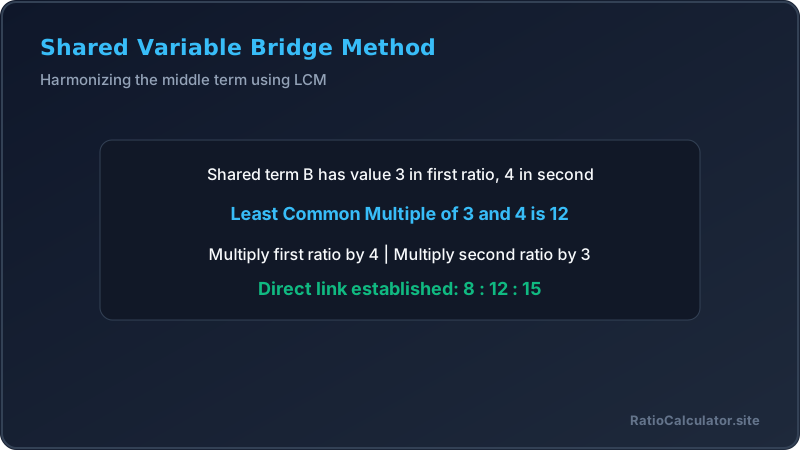
Once you have the combined ratio, you can read off the relationship between the two ends directly: here A : C = 8 : 15, even though the question never compared A with C.
Worked problem. In a school, the ratio of grade 9 students to grade 10 students is 4 : 5, and the ratio of grade 10 students to grade 11 students is 3 : 2. There are 120 grade 9 students. How many grade 11 students are there?
- The shared term is grade 10: 5 in the first ratio, 3 in the second. The LCM is 15.
- 4 : 5 becomes 12 : 15, and 3 : 2 becomes 15 : 10.
- Grade 9 : 10 : 11 = 12 : 15 : 10.
- Grade 9 is 12 parts and equals 120, so one part is 10. Grade 11 is 10 parts, so there are 100 grade 11 students (and 150 in grade 10).
Sharing a total in three parts
Add all three parts, find one part, and multiply.
Example. Three friends share $450 in the ratio 4 : 5 : 6. There are 4 + 5 + 6 = 15 parts, so one part is $450 ÷ 15 = $30. The shares are $120, $150, and $180.
The same method works for any number of parts. The full walkthrough, including decimal ratios, rounding money, and working backwards from one share, is in how to divide a number in a given ratio.
Finding a missing term
Example: 2 : 3 : 5 = 8 : 12 : x. The first terms give a scale factor of 8 ÷ 2 = 4. Check it on the second pair: 3 × 4 = 12, which matches. So x = 5 × 4 = 20.
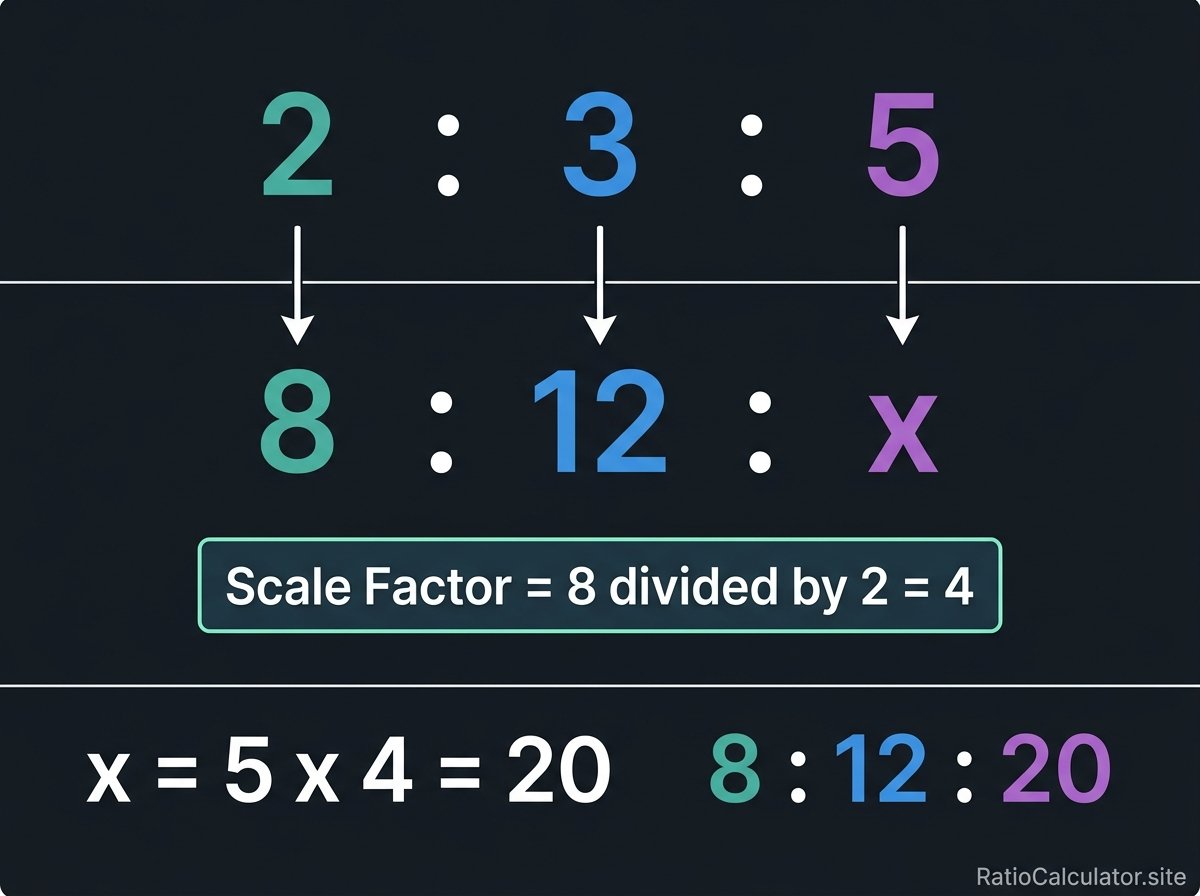
Always confirm the factor on a second pair. If 8 ÷ 2 and 12 ÷ 3 had given different answers, the two ratios wouldn’t be equivalent and there would be no valid x. For two-part ratios and cross-multiplication, see how to solve proportions.
Three short problems
Problem 1: A triangular plot
A triangular plot of land has sides of 75 m, 100 m, and 125 m. Write the side lengths as a simplified ratio.
The GCF of 75, 100, and 125 is 25, so the ratio is 3 : 4 : 5.
A 3 : 4 : 5 triangle is a right triangle, because 3² + 4² = 9 + 16 = 25 = 5². So this plot has a right angle between its 75 m and 100 m sides. (A rectangle couldn’t have these measurements: opposite sides of a rectangle are always equal, so it only ever has two different side lengths.)
Problem 2: Distances on a map
Three towns form a triangle. The distances between them are in the ratio 2 : 3 : 4, and the shortest distance is 50 km. Find the other two.
The shortest distance is the 2-part side, so one part is 50 ÷ 2 = 25 km. The others are 3 × 25 = 75 km and 4 × 25 = 100 km.
Problem 3: A recipe by weight
A cake uses flour, sugar, and butter in the ratio 4 : 2 : 1, and you want 280 g of the three together. There are 7 parts, so one part is 40 g: 160 g flour, 80 g sugar, 40 g butter.
Checking a three-part answer
Divide each value by its ratio number. In Problem 3, 160 ÷ 4, 80 ÷ 2, and 40 ÷ 1 all give 40. If the three results match, the values are in the right ratio. If the question gave a total, also check that the values add up to it.
Common mistakes
- Dividing only two of the three terms when simplifying.
- Writing A : B : C straight from two ratios without first making the shared term equal.
- Adding only two of the parts when sharing a total.
- Mixing units, such as meters with centimeters.